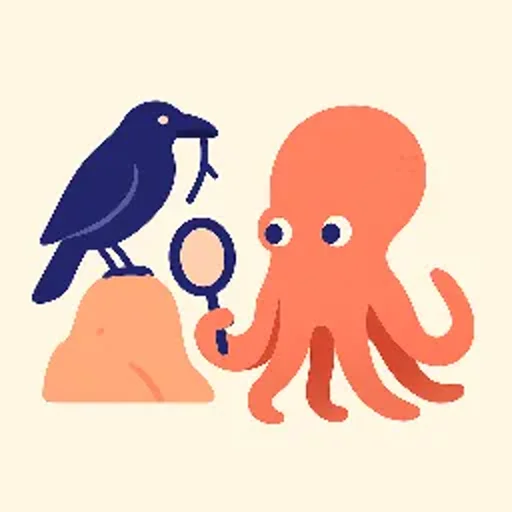
Crows, Octopuses and Dolphins: Different Animal Minds
The lesson looks at animal intelligence through three animals: crows with tool use and clustered neurons, octopuses with nervous systems spread through their arms, and dolphins that used mirrors to inspect marks on their bodies.
Read along
The full Gist, word for word. The small numbers link to the sources for each fact.
Can a bird tell one human face from another? Can an animal have a nervous system that reaches out into its arms? Crows, octopuses and dolphins each offer a different window onto animal brains and behavior. Scientists use the phrase animal intelligence for the mental abilities of animals.4
One way to measure those abilities is to watch how well a creature picks up something new or works its way through a problem.4 Researchers also look at how big an animal's brain is compared with the size of its body.1 That comparison has a formal name, the encephalization quotient.1 Alongside learning and problem solving, scientists weigh brain size against body size when they judge what an animal's mind can do.4,1
With those yardsticks in mind, the crow is a natural place to begin. At the University of Washington, John Marzluff has carried out research suggesting that crows can tell one human face from another.1 By that account, a crow may single out particular people rather than treating every human alike.1 Crows can also build tools and put them to work.3
Making a tool and using it are two separate skills, and crows show both.3 They have been seen hunting with sticks, and with hooks.3 Later studies went further and found that, out in the wild, New Caledonian crows bend their tools as a matter of habit.5 This was routine behavior among wild birds, not a one-time event.5
One New Caledonian crow even earned a nickname, double-oh-seven.5 This bird worked through a man-made puzzle that required eight separate steps.5 Each of those eight stages was distinct, and the puzzle itself was artificial, built by people rather than found in nature.5 What makes these feats stand out is the structure of the crow's brain.
Crow brains lack a region called the neocortex.5 In its place, evolution gave them tightly packed clusters of nerve cells.5 Those clusters give the birds mental ability on a par with what that missing region provides.5 Biologists have a term for this kind of pattern.
It is called convergent evolution.5 It describes how two lineages with entirely separate evolutionary pasts can arrive at the same trait or the same behavior.5 Crows and their relatives, alongside primates, are one example of this.5 A bird and a primate, in other words, can arrive at similar abilities from very different histories.5,5
The octopus offers a different kind of anatomy altogether. In an octopus, the nervous system is not gathered into a single central brain.1 Instead, it is distributed throughout the animal's arms.1 The octopus's body is unusual in other ways too.
Octopuses are invertebrates, and their blood is blue.3 That color comes from hemocyanin, a protein built around copper.3 One way to picture this is a company with decision makers stationed in every branch office, rather than all of them sitting at one headquarters. From the many-armed octopus, the story moves to a sea animal that has been tested with a mirror.
Researchers Reiss and Marino gave bottlenose dolphins a mirror test.1 Marks were placed on the dolphins' bodies.1 The dolphins then used the mirrors to look over those marks.1 The test, in other words, centered on whether these dolphins would use a reflection to inspect marked spots on their own bodies.1
Crows, octopuses and dolphins each give scientists a distinct way to study animal intelligence, from problem solving to brain structure to self-inspection in a mirror.4,5,1
Quick quiz
Lock it in: pick an answer to see if you got it.
1. According to the lesson, how is the nervous system of an octopus arranged?
Answer: Spread across its arms rather than in one central brain. The lesson says an octopus's nervous system is distributed throughout its arms instead of being concentrated in a single central brain.
2. What does convergent evolution describe, according to the lesson?
Answer: Completely different evolutionary histories leading to the same feature or behavior. Convergent evolution is when completely different evolutionary histories lead to the same feature or behavior, as with corvids and primates.
Sources
Every fact in this Gist is checked against these sources before it is published.
- Brainy Beasts: The Surprising Smarts of Crows, Pigs, and Dolphins - The Good Times
- Animal Intelligence Topic | Answers in Genesis
- Joyful Leaping Dolphins, Brooding Crows... Consciousness in Animals - KURIOUS
- Animal intelligence | animal behavior
- Crows could be the smartest animal other than primates
- Beyond Instinct: The Smartest Animals on Earth and What ...
Get a new Gist every day
1,000+ Gists on 37 topics in the GistWise app: a Gist of the Day every morning, quizzes, streaks and offline listening.