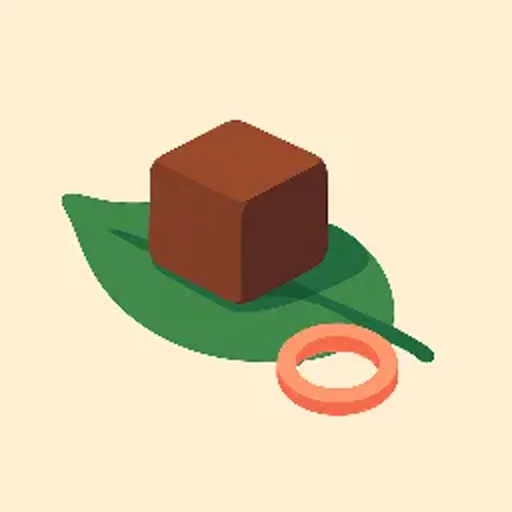
How Wombats Make Cube-Shaped Droppings
Wombats produce cube-shaped droppings even though their exit is round. The shape forms in the last part of the colon, where drying, muscle contractions and a gut wall with stiff and flexible zones shape it.
Read along
The full Gist, word for word. The small numbers link to the sources for each fact.
Picture droppings with flat sides and crisp corners, almost like a pair of dice. It sounds like a joke, but for the wombat, this is simply how digestion ends. Scientists describe wombat poop as little cubes, each one roughly 2 centimeters, or about 0.8 of an inch, from side to side.2 They also point out that no other creature in nature is known to produce anything like it.2
And the output is not small. In a single night, one wombat can leave behind as many as 100 of these tidy blocks.2 With shapes like that, a natural guess is that the animal must have a square exit. It does not.
Wombats have a round opening at the rear, just as other mammals do, and yet they skip the usual pellets, coils and untidy heaps.2 Researchers checked this directly. They ran a CT scan on a living adult female wombat, and the images revealed an ordinary round anus, matching every other animal.5 So the corners cannot come from the last moment of the journey.
The real story lies deeper inside the body. A research team at the University of Tasmania set out to find where the cubes actually appear. Their work showed that the shape forms near the very end of the gut, in the colon's final 17 percent.1 Before that point, the material has not yet taken on its boxy look.1
To learn why, the team studied how stretchy the intestine is, a property known as elasticity.3 They measured it in an unusual way, by blowing up a balloon inside intestines from wombats and from pigs, then watching how each one expanded.2,3 The pig intestine stretched in a fairly even way all the way around.3 According to the researchers, that even stretchiness would account for pig droppings coming out rounder.3
The wombat intestine told a different story. Around its circumference, it has two stiff zones and two flexible zones.1 The researchers say the cube comes from two processes working at once. As the feces sit in the colon, they dry out, and the gut's muscle contractions decide how big each piece is and where its corners fall.1
Wombat digestion is also slow. Food can take up to four times longer to pass through a wombat than through a human.1 That long trip allows the animal to draw out every bit of nourishment its meal can offer.1 Knowing how the cubes form still leaves a second puzzle.
Scientists and wildlife experts have also wondered why a cube might matter to a wombat at all. A popular story claims that wombats make cubes so they can pile them up and mark their territory. Wombat expert Mike Swinbourne rejects that, calling the stacking idea a misconception.3 In his view, the shape is more likely connected to the dry habitats that most wombats call home.3
Other experiments looked at how cubes behave once they are out in the world. In those tests, dough balls shaped like cubes were dropped onto a slope alongside dough balls shaped like spheres.5 The cubes traveled significantly shorter distances before coming to a stop.5 Those dough tests describe how the shapes move on a slope, and they stand on their own as a finding about cubes versus spheres.5
Together, these studies turn a strange piece of animal trivia into a detailed picture of anatomy. Wombat droppings gain their corners only in the colon's last 17 percent, and they still leave through a round opening.1,2 The wombat's cube-shaped droppings come not from a square exit but from drying, muscle contractions, and a gut wall with two stiff and two flexible areas.1,1,2
Quick quiz
Lock it in: pick an answer to see if you got it.
1. According to the University of Tasmania researchers, where in the gut do wombat droppings take on their cube shape?
Answer: Within the final 17 percent of the colon. The Tasmania team found that wombat cubes take shape within the final 17 percent of the colon.
2. What did the intestine measurements show about the wombat's gut wall, around its circumference?
Answer: It has two stiff areas and two flexible areas. The wombat intestine has two stiff areas and two flexible areas around its circumference, unlike the fairly uniform pig intestine.
Sources
Every fact in this Gist is checked against these sources before it is published.
- Why do wombats poop cubes? Scientists may finally have the answer | CNN
- Wombat poop: Scientists reveal mystery behind cube-shaped droppings
- Wombats have buns of steel—and they poop in cubes. Here's why. | National Geographic
- Wombat Cube-Shaped Poop Explained | PDF | Feces | Small Intestine
- Why do wombats poop cubes? – Why Evolution Is True
- Wombat Poop: The Science of Cubes | PDF
Get a new Gist every day
1,000+ Gists on 37 topics in the GistWise app: a Gist of the Day every morning, quizzes, streaks and offline listening.