Relativity: Motion, Light, Time and Curved Spacetime
The lesson tells Einstein's relativity as a story about motion, light and time, from special relativity's constant speed of light to general relativity's view of gravitation as the curvature of spacetime.
Read along
The full Gist, word for word. The small numbers link to the sources for each fact.
What if one of the most famous ideas in physics could be followed with little more than careful, everyday reasoning? Relativity has a reputation for fearsome mathematics, yet its core can be told as a story about motion, light and time. Einstein's first paper on the subject, published in 1905, is written in plain language.2 Most of the equations in it use nothing harder than algebra.2
That makes it possible to walk through the main ideas without a single formula. The story begins with a principle about motion. According to the principle of relativity, the rules of physics stay the same regardless of how someone happens to be moving.3 On this view, nobody can measure a speed that stands entirely on its own.2
Speed only makes sense as a comparison, the velocity of one object measured against another.2 Picture two trains sliding past each other on parallel tracks, each passenger watching the other window. This is only an illustration, but it captures the flavor of the idea. Each passenger can describe the other train as the one that is moving.
Einstein then added a second, surprising ingredient. In his proposal, anyone who measures the velocity of a beam of light would always find the same value, 186,000 miles per second.2 It does not matter how that observer is moving.2 Einstein argued that this speed, the speed of light in a vacuum, is the one and only absolute in his special theory of relativity.5
Once light holds that unique position, the rest of the theory looks very different from everyday intuition. Special relativity treats neither space nor time as fixed and universal.5 Measured distances and positions depend on where an observer happens to be.5 They also hinge on how that observer moves compared with whatever is being measured.5
The same goes for measuring how long something lasts.5 Two people in motion relative to each other can end up with different numbers for the same stretch of road or the same span of minutes.5 Time is especially strange in this picture. Observers who move relative to one another experience time in different ways.2
A pair of events might occur at the very same instant for one of them.2 For the other, those same two events might happen at separate moments.2 The idea of a single shared now, the same for everyone, does not survive in special relativity. The formulas that describe how distance and duration change with velocity were not invented by Einstein.5
Others had already worked them out more than a decade before his theory appeared.5 Gravity brings the story to its next chapter. He finished the most important pieces of a broader theory, called general relativity, in November 1915.4 Its central claim reshapes a very familiar force.
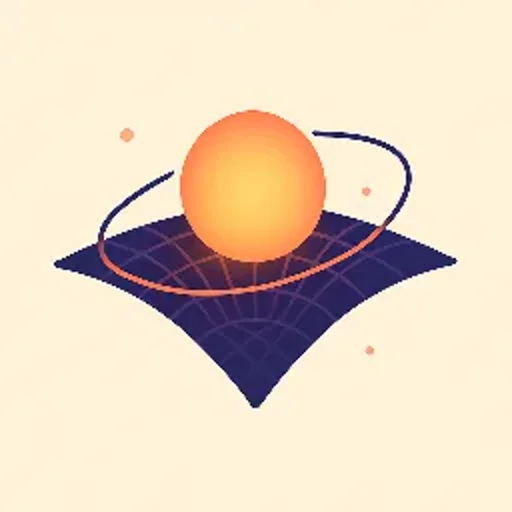
What has traditionally been called gravitation is, in this theory, the curvature of spacetime.4 Consider Earth and the sun. In Einstein's description, the sun's presence bends the spacetime around it.4 Earth then just keeps moving along on its own through that bent spacetime.4
In this account, the orbit is simply Earth's own unforced motion through a curved landscape that the sun has shaped.4 Gravity, in other words, becomes a feature of the shape of spacetime itself.4
Quick quiz
Lock it in: pick an answer to see if you got it.
1. According to Einstein's special theory of relativity, what is the only absolute?
Answer: The speed of light in a vacuum. The script says Einstein contended that the speed of light in a vacuum is the one and only absolute in special relativity.
2. In general relativity, what is traditionally called gravitation is described as what?
Answer: The curvature of spacetime. General relativity's central idea is that spacetime curvature is what has traditionally been called gravitation.
Sources
Every fact in this Gist is checked against these sources before it is published.
- How to understand Einstein’s relativity without math
- Einstein’s Relativity Explained in 4 Simple Steps | National Geographic
- The One Thing Everybody Should Know About Relativity
- General Relativity
- How to understand Einstein’s relativity without math
- Theory of relativity - Wikipedia
Get a new Gist every day
1,000+ Gists on 37 topics in the GistWise app: a Gist of the Day every morning, quizzes, streaks and offline listening.